
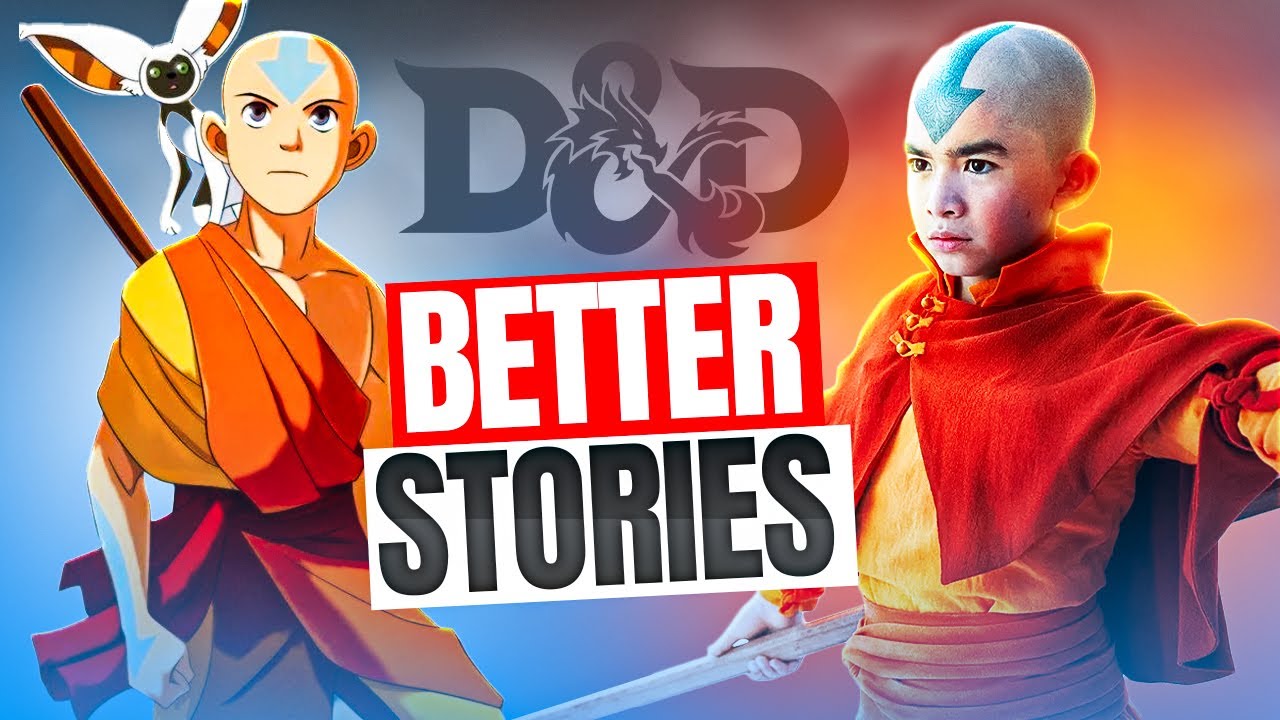
Intro
Hey, you. I know you are proud of your game. I know you probably think the D&D campaign you run is the best. And I know you are not ashamed of it.
But a very wise old man once said:
Pride is not the opposite of shame, but its source. True humility is the only antidote to shame.
That is Iroh, obviously. And here is the thing: there are things you are doing in your campaigns right now that you should be a little ashamed of. I am not judging, because I do them too.
I ran a poll on the channel a while back, and the answer was clear: narrative and plot are what DMs struggle with most. So after rewatching the animated series and then watching the entire live-action version, here are eleven lessons.
To be clear up front: we are not stealing plot points. We are looking at storytelling practices — the things Avatar: The Last Airbender does structurally that you can lift straight into your table.
1. Embrace your inciting incident
For those who have not been in an English classroom in a while: the inciting incident is the moment the characters can no longer return to the world they were living in. The point of no return. It is where momentum starts climbing and does not stop until the story ends — or at least until they get a breather.
Avatar does this within the first five minutes of the first episode. Sokka and Katara find Aang, and it does not just change their lives — it changes the entire political ecosystem of the world.
I understand it is harder without a single main character. But when your campaign starts, your players should feel thrust into something that will not stop until they stop it. Until they are the ones to plant a foot and end it.
Here is the simple version. The party has lived in this village for a good chunk of their lives. They are level one, two, maybe three — there is nothing they can do about large threats. The kingdom to the west invades. They have no choice but to abandon their homes and run. They cannot fight back.
That should happen inside the first hour of session one. You have maybe two to four hours in a session. Let the players mingle, get to know the town, come to love it a little. But within that first hour, push them out of their lives and make sure they cannot return to stasis until the story concludes.
The gang in Avatar get small breaks along the way, but the journey is not done until the Fire Lord is defeated. That is the driving pressure of the whole show. Keep that pressure on your players all campaign long and you will have a genuinely memorable antagonist — even if, in my example, they are just the general of the army or the enemy queen. They are the one who has to be stopped, and when they are, the war is over.
This is the whole subject of the worst way to start a D&D campaign — the three-part opening that gets you to an inciting incident inside the first hour instead of “you all meet in a tavern.”
2. Leverage soft magic and soft mechanics
Sometimes bending the rules for the sake of narrative and character development leads to unforgettable moments.
Most of the bending in Avatar is very soft magic. There are no sigils, no runes, no material components. You move your arms in a complicated way and rocks fly out of the ground.
So every once in a while, let your players approach their magic, their martial abilities, or the mechanics on their sheet in a soft way.
I have done this. Two sorcerers in one of my campaigns challenged each other to a duel, and I looked at the player — his name is Jamie — and said: ignore your character sheet. Do not look at your spells. Tell me what you want to do.
With creative players, that goes places. In that campaign it was explosive. It was wild.
But it needs consequences
Aang entering the Avatar State is soft magic too. You can draw on the power of every avatar before you. Incredible. But if you die in the Avatar State, the reincarnation cycle ends forever.
Oh. That sucks. So you use it sparingly.
Build the same weight into yours. Maybe if that mage is knocked unconscious while pulling that much power out of the Weave, they are cut off — no fifth-, sixth-, or seventh-level spells for two weeks afterwards.
You can invent mechanics on the fly to reward creative players and make memorable moments. Just make sure those moments still have stakes, and still have consequences if the player fails.
3. Be flexible with your storytelling
You are out of your mind if you think that in episode two or three of Avatar, the writers sat down and went: right, Zuko gets redeemed, and he teaches Aang firebending, and he has a sister, and the sister betrays him, and also his father had the previous Fire Lord assassinated, and—
No. What happened in those moments was genuine, organic storytelling. (Do not get me wrong, they forced some things. “The Great Divide” exists. Trash episode.) Maybe they did have it all mapped from the very beginning. But what makes the show feel so good is that it does not read that way.
Which is the valuable part for you. When you are worldbuilding, drafting, developing the plot — do not come up with every minute detail. You are not writing a book. You are not writing a story that depends only on your own thoughts.
What you need is a beginning and an ending, and the truth of the situation in between. Who is the big bad? Are they concealing their identity? What is their end goal? How are they starting?
If you know those things, everything in the middle can happen organically, in reaction to what the players do.
Take my evil king. Maybe he has a general, and that general is the one who attacks the village. And a few sessions later, that general — who has started to feel like they are not doing the right thing — tracks the party down and spares them. The party sees genuine humanity in this person. That opens an entire branch of story that you never planned.
Do not plan steps one through ten. Know what step one is. Know what step ten is. Let the rest fill in.
That is how you get moments like the Western Air Temple, where Zuko tries to join the group, fails, is rejected, and has to actually earn the connection by the end of the episode. Those are the moments to aim for.
Knowing “the truth of the situation” is mostly a question about your villain, which is why six tips to never have a boring BBEG again pairs so well with this — especially the part about letting their past decisions reach the party before they ever meet.
4. Pick a campaign structure that actually suits you
If you are planning a sprawling, exploratory campaign, take your cues from the episodic nature of the animated series. For something more condensed, take the tighter, serialised approach of the live-action series — which, by the way, is very good. It is different. It is a remake. It is still good.
The distinction matters more than people think.
- Episodic: a new place, a new problem, more or less every session. The overarching plot is still there — it is just underneath everything.
- Serialised: every session is visibly building toward the end goal. The main plotline is the main event, every time.
Take the village example. In an episodic version, the party gets pushed out and then spends each session on something different — delving a dungeon for something that might help them retake their home, sailing somewhere exotic, growing in power. Nothing is directly tied to the main conflict; they are just getting stronger.
In a serialised version, every place they go connects. They need to warn the next town and help it defend itself. They learn the king’s advisor is a lich, so they go into the crypt to find and destroy the phylactery, and then go destroy the advisor who has been poisoning the king’s mind.
Here is what I have learned: really long campaigns benefit from an episodic streak, because it keeps the narrative fresh, and it means that when the main plot does surface it lands harder. Running a long serialised campaign where you deal with the main story every single session can be genuinely draining. There is nothing wrong with it. Just know it is a marathon, not a sprint.
Mark went considerably further down this road in five campaign structures worth trying — anthologies, episodic journeys, and three stranger options if neither of these two shapes fits your table.
5. Encourage proper character growth
Character growth is one of the hardest things to get, because you are playing with people who probably do not have a storytelling background. They have played video games, watched films, read books. They may never have made art, or written something, or learned Aristotelian plot structure. They probably have not.
But here is what they do understand: they know what it is like to be a person, and to change over time as a person.
So the best tool you have — and Avatar uses it in nearly every episode — is to challenge their beliefs. Challenge their ideas. Challenge the way a character sees the world, and watch them either double down or begin to change their mind.
Use it on your NPCs. Use it on your player characters.
If one of your characters hates elves more than anything, hopefully there is a reason in their backstory for it — it should never just be racism for fun. But if the reason is there, start pressing on it. Put things in front of them that contradict their ideology, and let that cause them to grow.
Zuko’s entire redemption arc is this. He goes from believing the rest of the world is beneath him to living among the people his own nation has ground down — and seeing that they are just people, and good ones. “Zuko Alone” is a masterclass in showing rather than telling: it never says Zuko can care. It shows it.
You are forcing a character to change by introducing them to a concept that was alien to them moments before. That is a powerful device.
And it runs both ways: when your players challenge your NPCs, do not write it off. Do not deny on reflex. That is where the interesting flexibility lives.
The payoffs from this are the substance of five character evolution moments every campaign needs — the belief-challenging is the setup; those are the scenes where it cashes out.
6. Use comedy effectively
Comedy should enrich character development and enrich the story. It should not undercut serious moments.
You have to pick and choose as a DM: which moments are you doubling down on as serious, and which ones are you fine letting get silly? Because D&D players left to their own devices are going to get silly. That is just the truth.
Look at the ratios in the animated series. Every episode is roughly five minutes of serious, five minutes of comedy, and ten minutes of neutral, out of twenty to twenty-five. Some episodes lean one way, some the other. But there is a balance.
The most iconic comedic episode is “The Ember Island Players” — a parody of the entire series up to that point, and one of the funniest things the show ever did. And it is still full of gripping character moments. Real anxieties and real fears, framed by comedy.
So do not try to make all four hours of every session pure drama. Build in the balance, and you get two things at once: your players have fun being silly, and the serious moments hit harder — because they were laughing three minutes ago, and now drama is at their doorstep and they have to deal with it.
The comedy should not undercut the drama. The two should live in separate spaces.
7. Integrate new characters properly
Avatar introduces Toph Beifong about as well as it is possible to introduce a character, and the reason is that she does not simply appear.
A few episodes earlier, Aang receives a vision that he has to learn earthbending from someone who waits and listens — from Bumi. And before even that, he sees a vision of a girl with a flying boar in the swamp. All of it is foreshadowing Toph’s eventual arrival.
So here is my tip. When someone wants to join your campaign, you will be tempted to put them in that same session. Your friend asks on Tuesday, you are thrilled, you say yes, and boom — they are in on Thursday.
That can work. But if you want it to have real narrative weight, wait a couple of weeks. Drop small pieces of foreshadowing. Build the character up. Then when they arrive, they are not some random hobo off the street — they are the thing the party has been hearing about for three sessions.
And the other reason Toph works: she is needed. The party cannot succeed without her.
Your new player characters should be the same. Whatever happened to the party in session one, something equally bad and equally connected happened to this person. Now they are seeking the party out, because they found something — they have information the party needs.
8. Simplify your worldbuilding
In the world of Avatar there are four nations. Fire, earth, air, water. That is it.
And look at how cleanly it is arranged: one nation is the bad guy, one nation is dead, one nation is underpowered, and one is the only one capable of challenging the dominant force. Sure, there are floating oddities like Guru Pathik. But the structure is dead simple, which makes it effortless for a viewer to step in and understand what is going on.
I know a lot of us want our campaigns to feel like Game of Thrones — that complex political web. But George R. R. Martin has said himself that he did not know all of that from the beginning. A Song of Ice and Fire started because he had an image of a group of medieval people finding a litter of direwolf pups.
That is where the world started. People finding lost animals.
Then the layers come
Here is the part people miss. As Avatar goes on, the world does become complex. The Spirit World arrives, and then goes deeper. Not everyone in the Earth Kingdom is good. The Water Tribes are not uniformly underpowered — the Northern Water Tribe is formidable. Not everyone in the Fire Nation is evil.
The layers keep getting added the longer the story runs. Do that in your campaign.
Most people struggle to start a campaign because they think they need Seven Kingdoms, hundreds of houses, thousands of NPCs. Stop. You do not need that.
You need one town, four or five NPCs, and an inciting incident. Where does it go wrong? What happens that makes the players leave? That is all you need to begin, and from there you can layer it into something larger.
Avatar proves it. The premise and the inciting incident, in one sentence: “and then, one day, the Fire Nation attacked.”
This is the same instinct as Tolkien’s, from the opposite direction — depth that is felt rather than recited. His foreword to The Fellowship of the Ring is basically a manifesto for the iceberg, and worth reading before your next session-one lore dump.
9. Value your martial classes
There is one episode of Avatar that has shaped how I build characters and how I DM more than almost any other: “Sokka’s Master.”
In nearly every episode, Sokka is the joke in some way. Sometimes he proves himself and does something genuinely cool. But the crucial fact is that Sokka is not a bender. He is a fighter.
Think about every time you have had a fighter at your table say, yeah, I do not really know how to contribute here — the only spell I can cast is “swing.”
You need to make “Sokka’s Master” moments for your martial classes. Moments where they are unquestionably the coolest person in the room, and where their simple, mundane equipment makes all the difference. Think about how often Sokka’s boomerang matters, and how much it matters when it does.
Most DMs let the spellcasters do the heavy lifting on big set pieces, and then when the martial player comes with an idea, it is ooh, that is a little much, I am not comfortable, I do not want to break the rules.
Break the rules. I do not care. Break them so the martial player feels like they are doing something. Let them have the meteorite sword. Let them have the boots of jumping and let them leap onto a dragon and stab it repeatedly.
If you want a structural fix rather than a per-moment one, this is exactly what secondary objectives solve — give the fighter a ritual to interrupt or a prisoner to cut loose and they stop experiencing combat as “swing, miss, wait.”
10. Use foils and sages
Another one you may have missed in English class. As a former English teacher: please pay attention in class.
Sages are the characters who help your protagonists grow wiser. They give advice and help them along the path. Iroh for Zuko. Avatar Roku for Aang. In your campaign, these are the wise wizards your players seek out to learn things.
What you should steal is that these sages are not infallible. Roku made mistakes. Iroh made plenty. They became wise because of those mistakes, not in spite of them — they were not perfect their whole lives.
That matters mechanically as well as thematically. An NPC who seems too good to be true will make your party suspicious, and then that is a whole thing. Give your sages flaws. Give them things they got badly wrong. And give them the power to have learned from it.
Foils are characters who work in opposition to another and encourage growth through that contrast. Toph and Zuko both foil Aang.
The show says it outright: air and earth are opposite ends of the spectrum. Toph shows Aang that he has to plant his feet and face things head-on — he cannot keep running and jumping away. And Zuko is the other side of Aang entirely. The Fire Lord and the Avatar wind around each other for the whole story. Zuko’s anger and viciousness end up proving to Aang that even someone like Zuko can change, regardless of the path they started on. They foil each other and they grow each other.
Apply this at session zero
When you are helping players build characters, use this deliberately. If someone arrives with a fully fleshed-out concept, start advising the other players on personality traits that might create friction with it.
Session zero and the weeks leading into session one are where a strong party dynamic actually gets made. Make sure your characters do not merely get along — make sure they also have real things they disagree about.
Because growth comes from disagreement, and disagreement comes from people holding different opinions. That is what foils are for. It is all connected.
Bonus: 11. Fail forward
I said this passively in the secondary objectives video, and it deserves its own place.
Failing forward means failure is not the end of the story — it is a pivotal moment in the story.
Take “The Day of Black Sun” and the episodes around it. This is the moment they are going to get the Fire Lord early, before Sozin’s Comet, before they have to. Which is what we want.
And the plan fails. Every ally they gathered, everyone who came to trust the Avatar and showed up that day, and a great many of them get captured.
But the story did not end. It continued — into something more interesting and more exciting than the version where the plan worked. It gave them something specific to fight for, and it set up one of the best sequences in the show when they go back for a prison break.
Failure can be heartbreaking for players, and I understand exactly why. D&D is a game, and losing at a game does not feel good. But we need to change how we frame that moment psychologically, because just because you lost a fight does not mean you lost the game.
You are trying to tell a story. Some of the most real moments in any story happen when the characters get so close and cannot quite reach it, and have to retreat and live to fight another day.
So when the party fails, do not reflexively TPK and declare the campaign over. As a DM, do everything in your power to improvise a way for them to get out, survive, and come back victorious later.
The related trick is making sure that reversal feels like the story turning rather than the DM cheating. There are rules for subverting expectations without robbing your players, and a failed plan is exactly the situation they cover.
Closing Thoughts
Eleven lessons, and there is no twelfth hidden away. That is genuinely it.
If I had to compress all of them into one idea, it is this: Avatar is not good because the writers knew everything up front. It is good because they knew the shape — four nations, one Fire Lord, one boy in an iceberg — and then let a hundred episodes of character work fill in the middle honestly.
You can do that. One town. Five NPCs. An inciting incident. Then let your players be people in it, challenge what they believe, let them fail sometimes, and give the fighter a moment with a boomerang.
Is there a specific moment in Avatar: The Last Airbender that has inspired something in your campaigns? I would love to hear it — drop it in the comments on the video.