
Intro
Nobody wakes up one day with a fully formed fantasy setting sitting ready in their head. Inspiration has to come from somewhere.
For me it comes from everywhere. Books, plays, musicals, films, video games — I’ll take anything. Some of these have genuinely shaped how I run games, how I write, and how I think about storytelling at all.
So this one’s a little different. I want to go through the big ones, share the passages that stuck, and gush a bit. I believe inspiration and passion are infectious: if you see someone properly amped about something, there’s a decent chance it lights something in you too.
And since it’s my list, yes, we’re going to be talking about a lot of fantasy. But I’ll also flag how you might pull each one into your own game.
Books
The Wheel of Time
Fantasy books were my gateway into worldbuilding, character arcs, and the weight of a good story. Few series hit harder than this one.
There’s a sequence in The Great Hunt where Rand experiences a hundred possible lives in the space of seconds, each one flickering past:
He was a soldier. He was a shepherd. He was a beggar and a king. He was a farmer, gleeman, sailor, carpenter. He was born, lived, and died… At the end of every life, as he lay dying, as he drew his final breath, a voice whispered in his ear. Every life. Every variation. And at the end of each one, the same voice: I have won again, Lews Therin.
It captures fate in a way very few stories manage, and it’s genuinely terrifying — the idea that no matter what he does, he’s caught in the cycle, always bending toward the same confrontation. It makes the world feel enormous and the stakes feel inescapable.
For your game: weave fate into your storytelling. Give players visions, prophecies, glimpses of possibilities where their choices didn’t matter. Let them feel the pull of destiny — but always leave them a way to fight back. (That tension between inevitability and agency is the whole subject of why cosmic stakes aren’t enough, if you want to go deeper.)
A Song of Ice and Fire
My favourite thing about George R. R. Martin is that he doesn’t just write fantasy, he writes people. His worlds feel alive because his characters are complicated — they lie, they struggle, and crucially they make mistakes.
There’s a passage where Sansa looks out at the snow:
The colors had fled the world outside. It was a place of whites and blacks and grays… I do not belong here, Sansa thought.
A few lines, and you feel the isolation and the beauty at once. Sansa is one of my favourite characters to read for exactly this — that loneliness is such an interesting thing to sit with in someone so young.
But the passage that really shaped how I run morally grey NPCs is a conversation between Sansa and the Hound. She asks whether he’s afraid the gods will send him to some terrible hell for the evil he’s done.
"What gods? … If there are gods, they made sheep so wolves could eat mutton, and they made the weak for the strong to play with."
"True knights protect the weak."
"There are no true knights, no more than there are gods. If you can’t protect yourself, die and get out of the way of those who can. Sharp steel and strong arms rule this world. Don’t ever believe any different."
"You’re awful."
"I’m honest. It’s the world that’s awful."
That’s why these characters hit. The series refuses to hand you a clear moral line. Everyone has a worldview warped by the world that made them, and each of them has a coherent idea of what’s necessary and what’s right.
For your game: make your villains believe they’re the hero, or at least that they’re doing what has to be done — even when they know it isn’t good. Give them a worldview that makes internal sense, however terrifying it is from outside.
The Lord of the Rings
I’ll be honest: I don’t entirely know how you translate these into a D&D game beyond "wow, that was awesome, I love fantasy." But they matter to me, so here they are.
Sam, in the depths of Mordor, catches sight of a star:
The beauty of it smote his heart, as he looked up out of that forsaken land, and hope returned to him. For like a shaft, clear and cold, the thought pierced him that in the end the Shadow was only a small and passing thing: there was light and high beauty for ever beyond its reach.
Sam’s whole outlook is so refreshing for a character to carry — the ability to recognise beauty and hold onto hope, and to keep pushing everyone else forward with it. It’s very easy to be doom and gloom when things are terrible. It is extraordinarily difficult to keep hope in the face of it.
And Faramir — my boy Faramir:
I do not love the bright sword for its sharpness, nor the arrow for its swiftness, nor the warrior for his glory. I love only that which they defend.
I read these and immediately think: how do I get an NPC who speaks that poetically? Realistically, not every time. But one thing I do is take lines from books, films, shows and games I love and ask how I could rework them for a specific NPC.
A word on "stealing"
Because here’s the thing — everything is a remix. Everything is an iteration on an iteration. Anything you make, somebody can point at and say "isn’t that three other things stuck together?"
And at that point, if it genuinely is three things combined into something new, that’s not theft. Theft is going "my story is about a wizards’ council; there’s a Gandalf, a Dumbledore and a Merlin, and they do things together." Taking elements and building your own thing out of them is remixing your inspirations.
This is a stupid analogy, but: if somebody uses sticks to make fire, they’ve made something new out of sticks. Nobody says well, you’re just stealing from sticks.
Art is more complicated than that, obviously. But same vibe. Don’t tell people they’re stealing from sticks.
One more: the Sword Mage series
Quick, punchy, fun. If you struggle with reading, as I do, I genuinely recommend it — it’s short and snappy and it is pure D&D energy, taking you through some great corners of Faerûn. Good for campaign ideas, and better still for seeing how a world can push back on the people moving through it.
Shout out to my wife Kayla, who recommended it about nine years before I got round to reading it. Sorry that took a while. Really enjoyed it.
Theatre
Books are one medium. The stage is another — and my background is in theatre education, so of course this was going to show up.
I’m a firm believer that if you want to be a great DM, study theatre. Plays live and die on dialogue, tension and stakes. Few people understood that better than Shakespeare.
Macbeth
Near the end of the play, after Macbeth learns his wife is dead:
Tomorrow, and tomorrow, and tomorrow, Creeps in this petty pace from day to day, To the last syllable of recorded time… Life’s but a walking shadow, a poor player That struts and frets his hour upon the stage And then is heard no more. It is a tale Told by an idiot, full of sound and fury, Signifying nothing.
If you don’t have a deep love of Shakespeare you probably just went why is this man like this. Fair. But I read that and think: how do I make something in my world where my players hear a line and physically react? That’s the goal. That visceral, out-loud response.
Richard III
If you want political intrigue, genuinely just lift Richard III. A duke in a royal court destroys his family and every political ally he has to claw his way to the crown — and then discovers he has nobody left to protect him.
And if you want prophecy and paranoia, do something Macbeth-shaped. Which loops right back to the Wheel of Time and inescapable fate. My rule of thumb: fate can be inescapable for an NPC. For a player character, give them a way out.
Musicals
Hadestown
Orpheus was a poor boy, but he had a gift to give: he could make you see how the world could be, in spite of the way that it is.
If you want to understand why storytelling can be so powerful, Hadestown nails it. It isn’t just about telling a story — it’s about making people feel it. Connected to the characters and what happens to them.
That’s what you want at the table. When a player character heroically sacrifices themselves for the party, you want the reaction to be a stunned "…yeah, man." Not a pout about losing a character sheet. Some players will pout regardless. But that’s what you’re aiming at.
Sweeney Todd, and Sondheim generally
Sondheim was a master of motifs — musical themes that repeat and decay across a story.
Unless you’re composing custom music for your campaign (and if you are, please send it to me), you might think motifs don’t apply. They do.
In my last campaign — actually a dual campaign, two groups in the same world fighting broadly the same big bad — I used a piece from Sicario as the villain’s theme. The second it started playing, my players began to panic. I didn’t have to say a word. The music did all the work.
Thanks to Ryan for that recommendation. It worked out.
Video Games
Uncharted — for set pieces and pacing. The jeep chase in Uncharted 4 is a masterclass: relentless, cinematic, and you genuinely don’t care that your agency amounts to "fire gun, move stick." You’re just in it. D&D needs more moments like that. Give your players a roller coaster and tell them plainly, "okay, we’re going into a bit of a cutscene here." That requires trust — and if they don’t trust you yet, that’s a conversation to have and a thing to earn.
Dark Souls, Elden Ring, and FromSoftware generally — you know exactly what I mean. The boss music, the bar appearing, the passive storytelling buried in item descriptions. Two things to steal: use FromSoft music for your boss fights, because no series has a deeper catalogue to pull from; and hide small lore details on the items and weapons your players find.
Skyrim — I have about 2,500 hours on Steam and I don’t feel great saying that. Most of it is probably mod troubleshooting. But Bethesda made exploration feel organic, and rewarding exploration properly is the single best thing that game does. If you lean toward sandbox play, that’s the model: give people enough to see and do that they never run out of directions.
Baldur’s Gate 3 — a perfect demonstration of why the scale of your story stakes needs to grow as the party levels. It also taught me how badly my players want to play dress-up.
And Then There’s the Movie
I’m cheating slightly, since I already mentioned the books. But The Lord of the Rings is the film that introduced me to fantasy. It was my gateway to the genre and nothing has ever clicked quite the same way since. (I’ve written more about what Tolkien’s own foreword teaches about storytelling, if you want that in more depth.)
There’s one moment in The Return of the King that defines everything I love about storytelling.
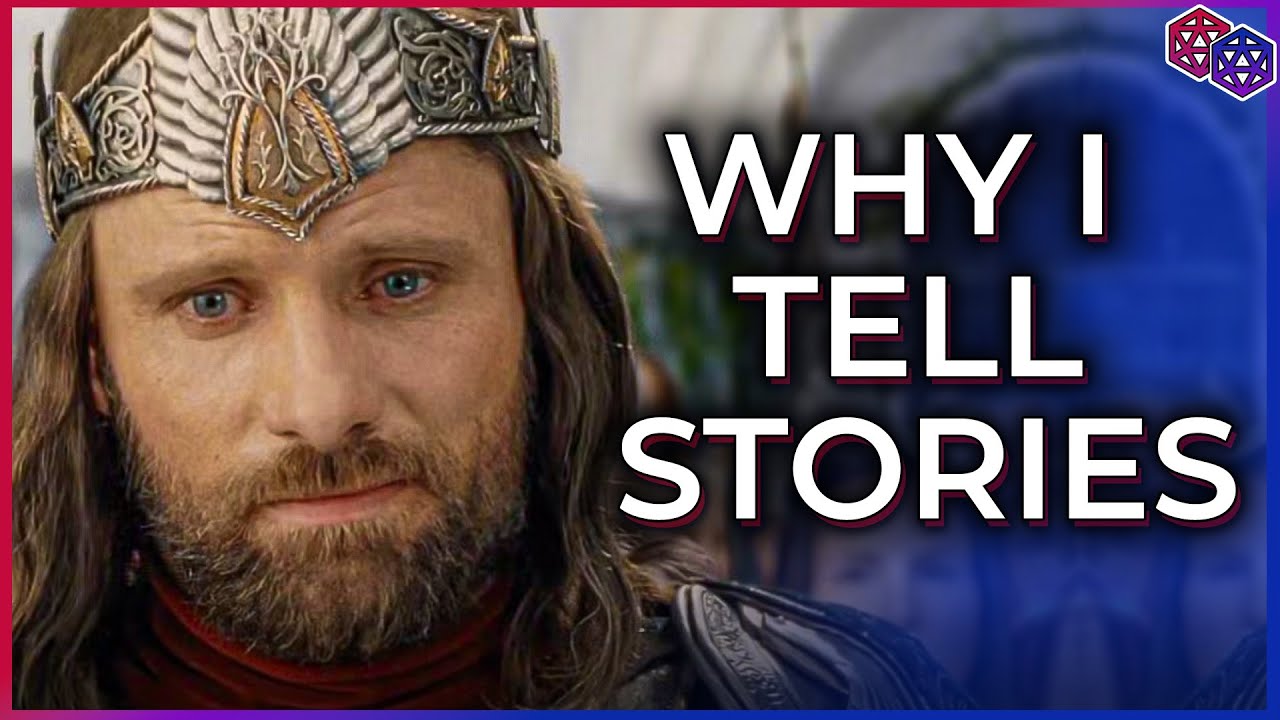
Aragorn is crowned. Everyone bows. And then he walks to the four hobbits — the ones who left their homes, went through hell, and saved the world — and instead of letting them kneel, he says:
"My friends… you bow to no one."
And the Shire theme swells in on brass.
It’s perfect. More importantly, it’s earned. That’s the kind of emotional payoff that stays with you for life.
And that’s what I want from the stories I tell. A moment where everything clicks, where the weight of the whole journey lands on you at once and you understand why it all mattered. Catharsis.
I remember finishing the War Against the Shadow campaigns — the final session, the characters at the celebration after the world was saved, the last conversations, the tears in the epilogue. It was the strangest feeling I’ve ever had. Joy and grief at the same time.
It’s a peculiar thing, spending years building something with your friends and then saying: okay. It’s done. It’s over. The story will live on, and we’ll always talk about those characters. But the story is finished being told.
That final moment of catharsis, and then — and that’s where we end this campaign.
If there’s something that inspires you, I’d love to hear it. Drop it in the comments on the video — give me more things to read, watch and play.